
01
Sure footing, wet or dry
A level, slip-resistant walk with no trip lips, so nobody comes a cropper on a rainy night.
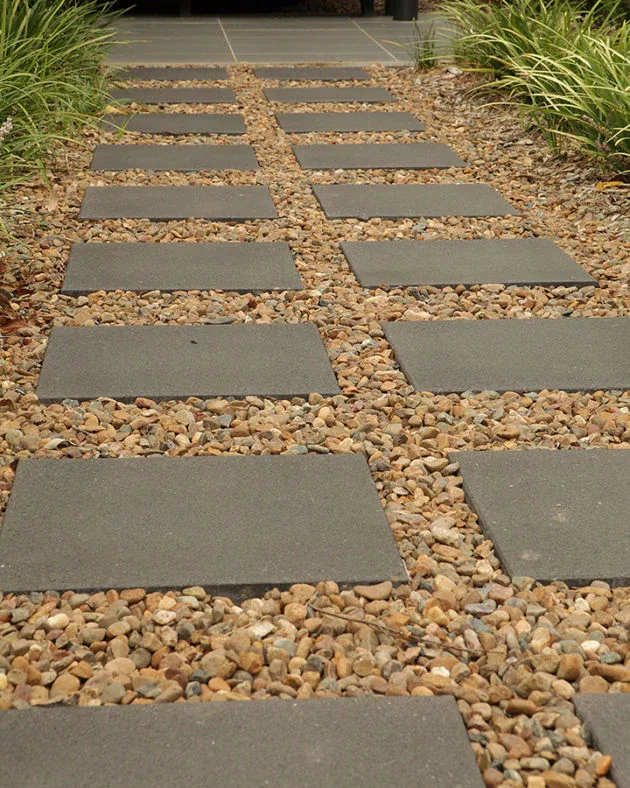
Walkway & pathway paving
The path from the gate to the front door, the side passage out to the wash line, the route to the braai — these get walked every day, in all weathers. We lay them level, slip-resistant and drained, with tidy edges that keep grass out of the joints.
Safe underfootSlip-resistant pavers laid dead level
Drainage built inFalls set so water runs off, not pools
Usually 1–3 daysMost garden paths from start to sweep
Overview
You walk the kids out to the car on it, carry the shopping in on it and lead guests round to the back. Left as bare ground, that route turns to mud in summer and a dust track in winter, and soon there's a worn line across the lawn where everyone cuts the corner.
A paved walkway sorts that out. Done properly it sits dead level, sheds water to the side, grips underfoot when it's wet and reads as part of the garden rather than a strip dropped on top. We lay garden paths, side passages, stepping-stone routes and large-format walkways to match your home paving and tie in with the patio.
In detail
A path carries less weight than a driveway, but it fails the same way if the groundwork is skipped.
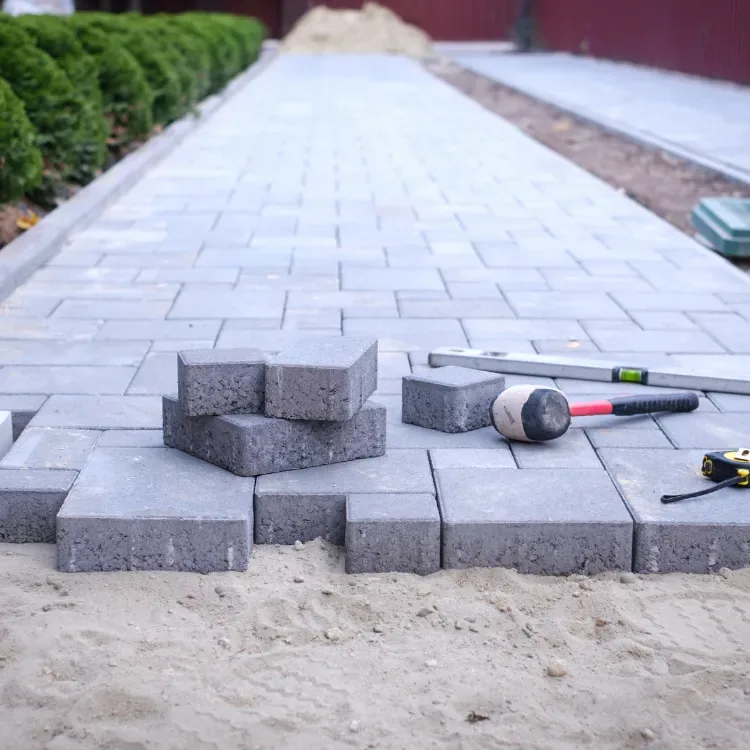
We strip the topsoil, bring the level down to firm ground, build up a compacted base, then a screeded bedding layer so every paver sits flush. On soft black-clay ground we dig deeper. That's what gives you a walk with no rocking pavers and no trip lip where one block has dropped below the next.
Paths get used in the rain, at night and by older feet that don't want a surprise, so the finish matters. Anywhere that stays wet — a shaded side passage, a pool surround, the foot of a slope — we use a textured or riven paver that grips, not a glassy one. Every path is laid to a slight cross-fall too, so rain runs off into the garden instead of puddling across it.
Without a restraint at the sides, a walkway slowly spreads, the joints open and the lawn creeps in. We finish every path with a proper edge — a haunched brick, a mowing strip or a flush kerb — so it holds its shape and you can run the mower straight over the join.
The side of the house is where a path is needed most and hardest to lay — often under a metre wide, gated at both ends, with a tap and a gully to work around. We barrow material in by hand, cut the pavers to thread past drains and meter boxes, and leave the passage swept and usable.
| Where it goes | Paver we usually reach for | Typical thickness | How it's laid |
|---|---|---|---|
| Garden path (everyday foot traffic) | Clay brick / interlock | 50 mm | Stretcher or herringbone |
| Side passage | Clay brick / interlock | 50 mm | Stretcher, run lengthwise |
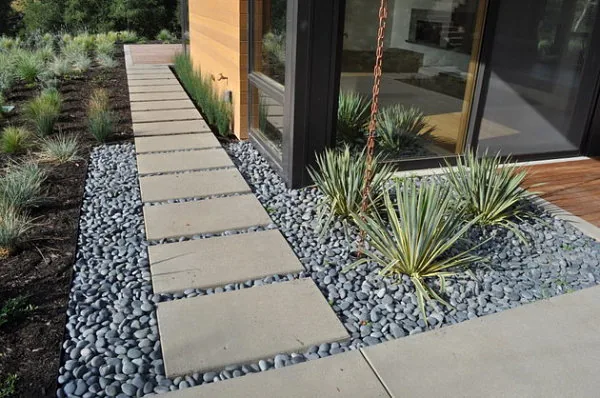
| Stepping stones in lawn | Large-format flag | 50 mm | Spaced to an easy stride |
| Modern large-format walk | 400×400 / 600×600 slab | 50 mm | Aligned joints, tight |
| Steps on a slope | Bullnose / brick edge | 50 mm | Cut to even tread & riser |
Guidance only. We confirm the right paver and thickness on site, based on your traffic, slope and soil.
Benefits
Safe, dry, tidy and easy to keep — a route you never have to think about.
01
A level, slip-resistant walk with no trip lips, so nobody comes a cropper on a rainy night.
02
Side passages stay walkable the morning after a Highveld thunderstorm, not a mud-slide.
03
A defined path takes the traffic, so the grass either side recovers.
04
Laid to a cross-fall, so rain runs off to the beds instead of pooling across the walk.
05
Matched to your driveway or patio in colour and pattern, a path links the spaces together.
06
An occasional sweep and a top-up of jointing sand is the whole list. No sealing, no fuss.
What's included
Set out, excavate, build, lay, finish and clean up — all in the fixed quote, nothing added later.
Free on-site assessmentWe walk the route, check the ground and quote in writing
Excavation & spoil removalDown to firm ground, the mess carted away
Compacted base & beddingScreeded flat so every paver sits flush
Edge restraintsHaunched brick, kerb or mowing strip so nothing spreads
Supply & laying of paversCut in neatly around taps, drains and every angle
Jointing sand & clean-upSwept in, compacted and the site left tidy
Why us for this
You can spot a wobbly paver. What you can't see on handover day is whether the base was compacted, whether the falls really carry water off, and whether the edges are held. Those decide whether your path is still level in five years or shifting after one wet season.
We build paths the same careful way we build driveways — the groundwork first, the good-looking part second. Our own teams do the work across the areas we serve in Gauteng, so the crew that quotes your job is the crew that lays it.
Level walk, safe fallsNo puddles, no trip lips
Slip-resistant finishGrippier pavers chosen for wet spots
Tidy in tight accessGarden left as we found it
Our own teamNot a subcontractor you'll never see again
Our process
Usually one to three working days for a home path, weather permitting.
01
We walk the route, check the ground, access and falls, talk pavers and patterns, and hand you a fixed written price.
02
Mark the line, excavate to firm ground, then lay and compact the base — barrowed in by hand where access is tight.
03
Cross-fall set for drainage, edge restraints fitted, and a screeded bedding layer laid dead flat.
04
Pavers laid to pattern, cut in around every obstacle, jointing sand swept in and the site left clean.
The side passage was a slippery mud strip every winter. They squeezed a proper brick path down it by hand, laid it to run the water off, and it hasn't been slick since.
FAQs
Cost, stepping stones, tight access, slopes and keeping it looking good.
Send a photo of the path or side passage on WhatsApp and we'll often give you a ballpark before we visit.
WhatsApp a photoIt depends on the paver and the width, but most garden paths come in between R220 and R500 per m² supplied and laid. Narrow paths and side passages are often easier to picture per running metre once we've seen the access and the ground. Either way, you get a fixed, itemised price at the free site visit.
Both have their place. Spaced flags set into lawn or gravel look relaxed, cost less and suit a low-traffic wander through the garden. A continuous paved path is firmer underfoot, works with prams and wheelbarrows, drains properly and never wears a muddy patch between the stones — so for a front entrance or a side passage we'd almost always lay a full path.
Yes — passages down to about 600mm are our bread and butter. We barrow everything in by hand rather than dragging machines through your garden, cut the pavers around taps, gullies and meter boxes, and leave it clean and level. Tight access takes a little longer, and we allow for that in the quote upfront.
A gentle slope we pave to follow the ground, with the fall running across the path so it doesn't become a stream in a storm. Once it's steeper than a comfortable walk, steps are safer than a slick ramp. We build them in matching pavers with a slip-resistant edge to each tread, set to an even rise so nobody misjudges them in the dark.
Not if the right paver is specified. For shaded, wet or sloping spots we use a textured or riven paver that keeps its grip, and we lay every path to shed water rather than hold it. Smooth, glazed pavers can get slick, so we keep those for dry, decorative areas.
Very little. Sweep or hose it now and then, and top up the jointing sand every couple of years so the joints stay full and weed-free. A path in a damp, shaded corner may grow a little moss — a wash with a stiff broom sorts it. If a section is ever lifted by a tree root, we can pull it up and re-lay it.
Related services
Next step
Tell us where the path needs to go and we'll come and look at the ground, the access and the falls, then put a fixed price in writing.
Free site visits · Fixed written quotes · Garden paths & walkways across Johannesburg and the wider Gauteng
Contact
Tell us your suburb and what you'd like paved. We'll arrange a free site visit and a fixed written quote — no obligation.