
01
Carries point loads without cracking
Jack legs, container corners and standing axles put tonnes onto a tiny footprint. Interlocking pavers spread that load into the base instead of failing at a single point the way a slab does.
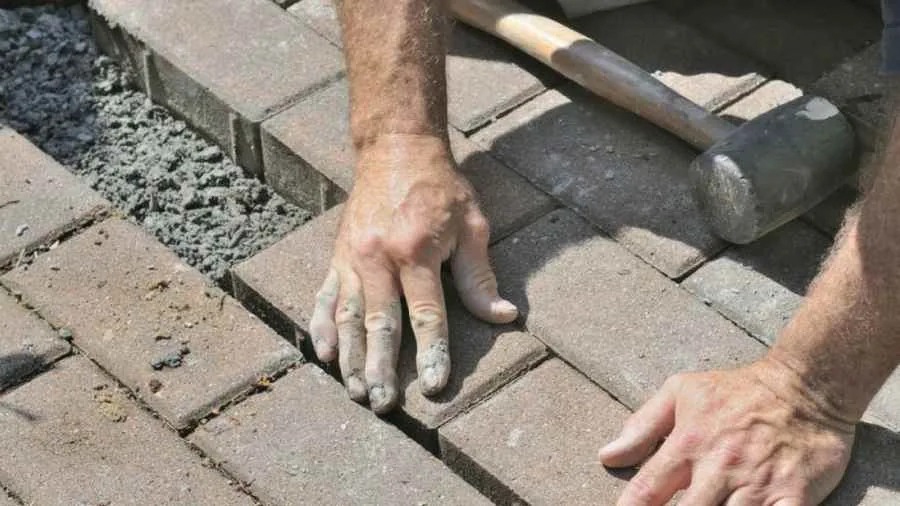
Home/Services/Industrial driveways & access roads
Heavy-duty access roads
Gates, weighbridges, dock approaches and the roads between buildings take a daily grind no ordinary driveway is built for — loaded trucks, turning trailers and standing point loads, shift after shift. We build access roads on a deep, engineered base with 80mm pavers, proper camber and edge restraints that hold the line, plus a surface you can spot-repair in a day when a service trench opens it up.
Built for point loads80mm pavers on a deep, engineered base
Camber & drainage built inFalls set so Highveld storms run off fast
Spot-repairableLift, fix the base, relay — no week-long closures
Overview
An industrial site rarely fails at the yard first — it fails at the road leading into it. The stretch from the gate to the weighbridge, the dock approach, the route that snakes between warehouses: these carry the same loaded trucks and turning trailers as the yard, but narrower, slower and under harder braking, which is exactly the combination that breaks a surface built for cars.
We treat access roads as their own engineering problem, not an afterthought tacked onto the main industrial paving job. Point loads are the real enemy here — a trailer's jack legs, a container corner, a fully laden wheel standing still while a load is checked at the weighbridge. Spread that same load across a parking bay and it barely registers; concentrate it onto a narrow road and a thinner surface tips or cracks. If what you actually need is bay-and-aisle parking rather than a haul route, our industrial parking lots page covers that side of the site, and if your entrance sees cars and delivery bakkies rather than interlinks, commercial driveway paving is the lighter-duty option.
We build and repair these roads for factories, depots and logistics parks right across Johannesburg, the East Rand and nodes like Kempton Park, where a single access road can see more truck movements in a week than a suburban street sees in a year.
In detail
Point loads, not just weight, are what break a road built to the wrong spec.
A loaded truck doesn't press evenly on a road — it presses hardest exactly where it brakes, turns or stands still. A trailer's jack legs, a container corner, an axle parked at the weighbridge: each puts a huge load through a tiny footprint, which is precisely what cracks a rigid slab and what a home driveway was never engineered for. We design the base around the worst point load on your site, not an average one.
For any route carrying trucks or trailers we specify an 80mm heavy-duty interlocking paver, a full 20mm thicker than a standard driveway block. Laid in herringbone, the interlocking angles resist the sideways shove of braking and turning wheels far better than a straight stretcher bond — exactly the movement that opens gaps and pumps jointing sand out of a lighter-duty surface.
The paver is the part you see; the base is the part that does the work. We excavate to firm ground and build up a compacted crushed-stone sub-base in layers — a G5-equivalent build-up as the baseline, stabilised further where the soil is soft or the traffic severe. Skimp here and no paver thickness above it will stop the road from rutting.
An access road with no restraint at the edges spreads outward under turning traffic until the joints open and blocks start to rock loose. We set a proper concrete haunch or kerb along the perimeter, so the whole field stays locked tight through years of trucks swinging wide at the gate or the dock door.
We build in a camber and set the falls so rain runs off to a channel drain or your stormwater point, never toward the weighbridge pit or a dock door. It matters more here than almost anywhere else on site — standing water on a haul road is both a rutting risk and a safety hazard for a driver easing a laden truck through.
| Access road / area | Recommended paver | Thickness | Base build-up |
|---|---|---|---|
| Light-vehicle access route | Interlocking | 60 mm | Compacted sub-base |
| Standard truck route | Heavy-duty interlocking | 80 mm | Deep engineered base |
| Loading approach & dock apron | Heavy-duty interlocking | 80 mm | Engineered, stabilised base |
| Weighbridge & gate apron | Heavy-duty interlocking | 80 mm+ | Base built to the load |
Guidance only. We confirm the exact spec on site, based on your traffic, point loads and ground conditions.
Benefits
Most of the value sits in the base, the thickness and the drainage — exactly what a cheap road leaves out.
01
Jack legs, container corners and standing axles put tonnes onto a tiny footprint. Interlocking pavers spread that load into the base instead of failing at a single point the way a slab does.
02
Herringbone bond and proper edge restraints stop the field spreading where trucks brake and swing wide at the gate, the dock or the weighbridge, shift after shift.
03
Built-in falls move rain to the drains, not toward the weighbridge pit or a dock door, so the road stays safe and usable straight through a Highveld storm.
04
A settled patch or a service trench means lifting a few blocks, fixing the base and relaying them — no saw-cutting, no re-casting, no week with the road half-closed.
05
A textured block surface keeps its grip wet or dry, where a worn slab or bleeding tar turns slick under a loaded truck.
06
Clean, level paving at the gate tells drivers, auditors and clients the operation is run properly before they're even through the boom.
What's included
Excavate, engineer, lay, drain and clean up — all in the fixed quote, nothing added later.
Free on-site assessmentWe walk the route, check the loads and quote in writing
Excavation to design depthDown to firm ground, spoil carted away
Deep, engineered sub-baseCrushed stone compacted in layers, stabilised where needed
80mm heavy-duty paversSupplied and laid to a herringbone bond
Edge restraints, camber & drainageConcrete haunching and falls built in for Highveld storms
Compaction, jointing sand & clean-upVibrated tight, sanded in and the site swept clean
Why us for this
Walk a finished access road on handover day and it looks the same whether the base underneath is right or badly short-cut. The difference shows up eighteen months later, when the wheel tracks at the gate start to rut and the joints at the dock door open up.
Whether the sub-base was compacted in true layers. Whether it was stabilised to suit your loads. Whether the camber genuinely sheds water and the edges are truly restrained — none of that is visible on day one. All of it decides whether the road is still flat and tight after ten years of trucks.
Base built to your loadLayered, compacted and stabilised where the ground needs it
Heavy edge restraintsSo the field can't spread under turning trucks
Camber that sheds stormsNo ponding at the gate or the dock door
Our own teamsOn your site, not a labour broker you'll never see again
Our process
Usually phased so trucks, deliveries and staff can still move while we build.
01
We walk the route, ask what actually crosses it — trucks, trailers, forklifts — check the ground and hand you a fixed written price.
02
Dig to design depth, cart away the spoil, then lay and compact the sub-base in layers.
03
Falls set for drainage, edge restraints fitted, and a screeded bedding layer laid dead flat.
04
80mm pavers laid to herringbone, cut in at every edge, vibrated down, jointing sand swept in and the road handed back clean.
The truck route to our dock used to pothole every rainy season no matter how many times the tar got patched. Rapid Paving dug it out, built a proper base and laid 80mm blocks with a real camber. Two seasons of loaded interlinks later it's still flat, and when the fibre crew trenched across it, they just lifted a few blocks and put them back.
FAQs
Loads, thickness, base depth, repairs and the guarantee.
Send us a photo of the route on WhatsApp and tell us what runs across it — we'll often give you a ballpark before we visit.
WhatsApp a photoYes. Interlocking pavers on a properly engineered base are used on ports, depots and container terminals for exactly this reason — the blocks flex and share the load between them, where a concrete or tar surface concentrates it until it cracks or ruts. We build the base to the traffic you actually run, so a road carrying interlinks daily gets a different spec to one carrying the odd delivery bakkie.
An 80mm heavy-duty interlocking paver, laid in a herringbone bond, on any route carrying trucks, trailers or standing point loads. The extra thickness over a standard 60mm driveway paver resists the tipping and cracking that concentrated wheel and jack loads cause, and herringbone stops the blocks walking out of line under constant braking and turning.
We excavate to firm ground, then build a deep sub-base of crushed stone in compacted layers — a G5-equivalent build-up as a minimum, stabilised further where the ground is soft or the loads severe. Each layer is vibrated tight before the next goes down. It's this hidden structure that carries the road; the pavers are just the wearing surface on top of it.
Yes, and it's one of the real advantages of block paving over a slab. If a section settles, a service trench cuts across it, or point loads have worked a patch loose, we lift the affected pavers, correct the base underneath and relay the same blocks — usually finished the same day, with no saw-cutting, no re-casting and no waiting for concrete to cure.
Yes — a written workmanship guarantee on our base preparation and installation, on top of the manufacturer's guarantee on the pavers themselves. Because the surface is modular, if any section does move we come back, correct the base and relay it, rather than you living with a rutted patch.
As a guide, heavy-duty access-road paving runs from around R220 per m² supplied and laid, moving up with paver grade, base depth and any ground stabilisation needed. Every site's traffic and soil are different, so the only reliable figure is the fixed, itemised quote we give after a free site visit.
Related services
Next step
Tell us what runs across it — trucks, trailers, forklifts — and we'll spec the base, the camber and the pavers to match. That's the difference between a road that holds for a decade and one that ruts by next winter.
Free site visits · Fixed written quotes · Industrial paving across Johannesburg and the wider Gauteng
Contact
Tell us your suburb and what you'd like paved. We'll arrange a free site visit and a fixed written quote — no obligation.